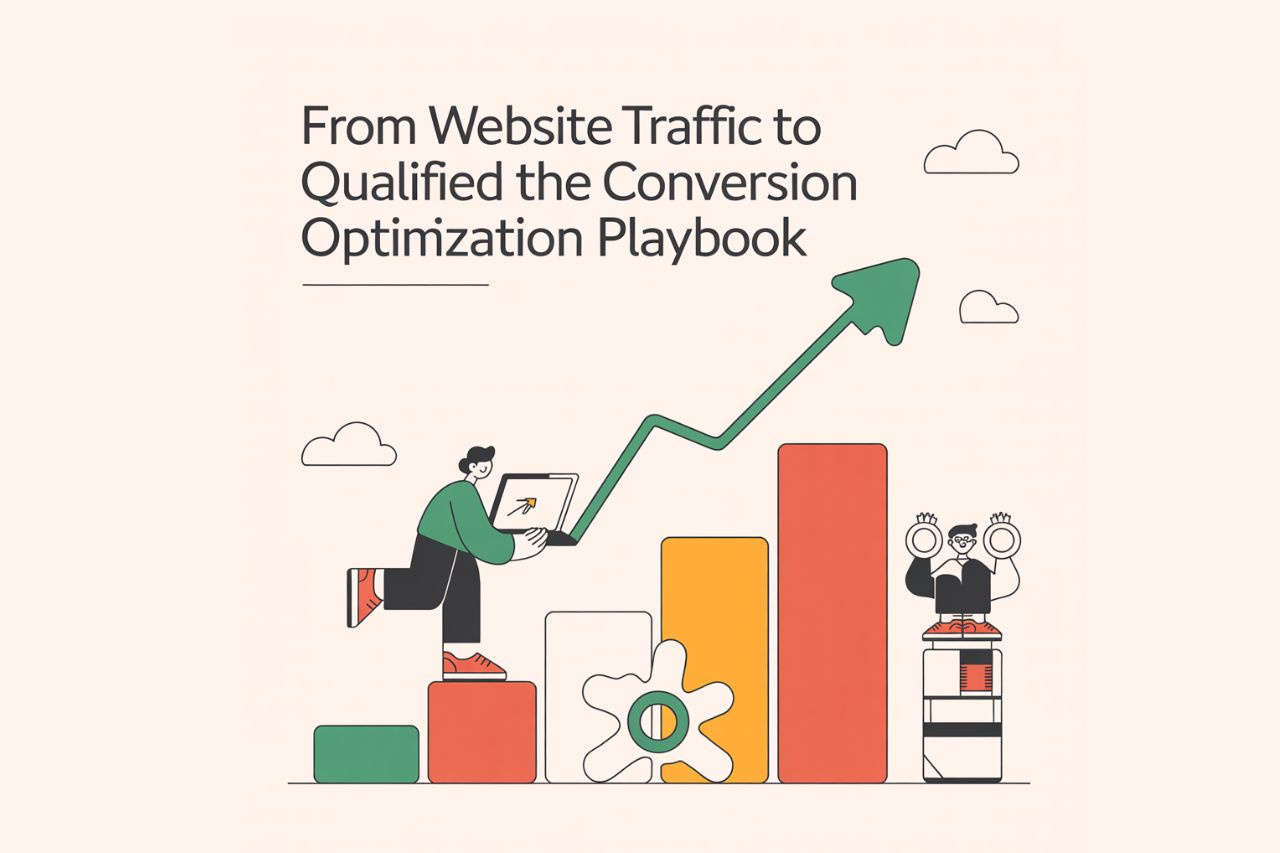
Introduction to Conversion Rate Optimization (CRO)
Most businesses make the same mistake.
They think traffic is everything.
But here’s the truth: traffic without conversions is useless.
You can get 100,000 visitors a month. If none of them buy, sign up, or call, your website is failing.
That’s where CRO—Conversion Rate Optimization—comes in.
CRO is all about turning clicks into customers. It’s about helping visitors take the next step instead of bouncing away.
Think of it like this:
Traffic is people walking into a store. CRO is making sure they leave with a bag in their hands.
If you’re spending money on ads, SEO, or social media, CRO makes every dollar work harder. You don’t need more traffic—you need better results from the traffic you already have.
And once you get CRO right, you won’t just get conversions—you’ll get qualified leads. The kind of leads that make your sales team happy. The kind that actually buy.
Why Traffic Alone Isn’t Enough
Here’s a hard pill to swallow: traffic doesn’t pay the bills.
Marketers love big numbers. Page views. Clicks. Followers.
But none of that matters if you can’t convert visitors into leads.
Let me explain with an example.
Imagine you own a restaurant. 500 people walk in, look around, and leave. Nobody eats. Nobody pays. That’s not success—it’s a disaster.
The same thing happens on websites every single day.
Businesses focus on traffic but forget conversions.
Sure, traffic matters. But what matters more is the quality of that traffic.
A small audience of the right people will always beat a big audience of random ones.
And that’s why focusing only on traffic is a trap. Ads get more expensive. SEO takes time. Social media reach keeps dropping.
If you don’t optimize for conversions, you’re pouring water into a leaky bucket.
The solution? CRO.
Instead of chasing more traffic, you squeeze the most out of the traffic you already have.
The True Value of Qualified Leads
Not all leads are equal.
Someone who casually visits your blog and leaves an email isn’t the same as someone who downloads your pricing guide.
One is curious. The other is ready to buy.
That’s the difference between a lead and a qualified lead.
Qualified leads are gold. Why?
- They fit your target customer profile.
- They have intent. They’re looking for solutions.
- They’re more likely to move down your funnel.
Here’s the beauty of qualified leads:
- Your sales cycle gets shorter.
- Your sales team wastes less time chasing cold prospects.
- Your revenue per lead goes up.
And there’s more. Qualified leads stick around longer. They buy more. They tell their friends. They have a higher lifetime value.
When you focus on CRO, you’re not just collecting random email addresses. You’re building a system that attracts, nurtures, and converts the right people.
That’s how you grow a business sustainably.
Understanding the Conversion Funnel
Think of your funnel as your customer’s journey. From the first click to the final conversion, every step matters.
If one stage is broken, people drop off. That’s money lost.
The Stages of the Funnel
- Awareness – People discover you. Maybe from Google, ads, or social media.
- Consideration – They check you out. Compare you with competitors. Read your content.
- Decision – They act. They sign up. They buy.
Sounds simple, right? But here’s the catch: most businesses optimize only the top of the funnel. They run ads. They write blog posts. But they forget the bottom—where the money is made.
CRO focuses on every stage.
- Awareness: Hook them fast.
- Consideration: Build trust.
- Decision: Make the next step easy.
The Psychology of Visitors
Conversions aren’t just about logic. They’re about psychology.
People buy with emotion and justify with logic.
That’s why small details—like page speed, headlines, or testimonials—make such a huge impact.
Think about these triggers:
- Urgency: “Limited time offer.”
- Scarcity: “Only 3 spots left.”
- Social proof: “Trusted by 10,000+ customers.”
These aren’t just marketing tricks. They tap into human behavior.
When you understand what makes people click, CRO becomes 10x more effective.
The Foundations of CRO Success
Before you jump into tactics, you need a solid foundation.
Think of CRO like building a house. You don’t start with the paint. You start with the foundation.
Here’s what you need:
1. Clear Conversion Goals
What does a conversion mean for your business?
- An e-commerce site: a sale.
- A SaaS company: a free trial signup.
- A service business: a booked call.
Without a clear goal, you can’t measure success.
Pick one primary goal and optimize for it. Everything else is secondary.
2. Business Goals + User Experience
Conversions should never feel forced.
If your forms are too long, if your CTAs are pushy, people will leave.
The goal is balance. You get the data you need. They get the value they want. Win-win.
For example: instead of asking for 10 form fields, ask for just name and email. Keep it simple.
3. Realistic Benchmarks
Here’s a reality check.
Most websites don’t convert at 20%.
The average e-commerce site converts at 2-3%.
B2B sites convert around 5-7%.
Don’t chase unrealistic numbers. Instead, benchmark your current rate, then work to improve it step by step.
Track these metrics:
- Bounce rate
- Time on page
- Click-through rate
- Form completions
Fix the leaks in your funnel, and watch your conversions grow.
Optimizing Website Design for Conversions
Your website is your digital salesperson. If it looks messy, slow, or outdated, visitors won’t trust you.
A great design builds trust. It makes people stay longer. And most importantly—it gets them to act.
First Impressions Matter
People form opinions about your site in 0.05 seconds. That’s faster than a blink.
What do they look at?
- Layout
- Colors
- Fonts
- Headline
If your site looks cheap, they’ll think your product is cheap.
If it looks professional, they’ll trust you more.
Use visual hierarchy to guide attention:
- Bigger fonts for headlines.
- Contrasting colors for CTAs.
- Whitespace to keep things clean.
Think of it like a road map for the eyes.
Mobile + Speed = Non-Negotiable
Over 50% of traffic is mobile. If your site isn’t mobile-friendly, you’re losing half your audience.
Speed matters too. A one-second delay can cut conversions by 7%.
Slow sites kill sales.
Quick wins:
- Compress images.
- Use a reliable host.
- Clean up unnecessary plugins or scripts.
Smooth Navigation
Visitors shouldn’t have to think about where to click. Navigation should feel natural.
Keep menus clear. Use breadcrumbs. Avoid clutter.
The easier it is to move around, the longer people stay—and the higher they convert.
A confusing website is like a maze. People get lost, frustrated, and leave.
Crafting Compelling Landing Pages
Landing pages are where the magic happens.
They’re not your homepage. They’re focused pages with one goal: get the visitor to act.
Clear Messaging Wins
In 5 seconds, your landing page should answer three questions:
- What is this?
- Why should I care?
- What do I do next?
Cut the fluff. Avoid jargon. Get to the point.
Strong CTAs
Your call-to-action (CTA) is the tipping point.
Don’t use boring buttons like “Submit.”
Use action-driven CTAs like:
- “Get My Free Trial”
- “Download the Guide”
- “Book My Demo”
Place CTAs above the fold and repeat them on the page. Make them impossible to miss.
Remove Distractions
A landing page should be laser-focused.
Don’t add extra links, menus, or popups. Each extra option is a distraction.
Focus on one offer. One CTA. One goal.
The more focused your landing page, the higher your conversion rate.
Leveraging Content Marketing for Conversions
Content isn’t just for traffic. It’s for conversions too.
Most businesses make the mistake of blogging for clicks. But clicks don’t matter unless they move people down the funnel.
Here’s how to make content work for CRO:
- Answer real problems. Blog posts, guides, and case studies should solve customer pain points.
- Add CTAs inside your content. Don’t wait until the end. Place CTAs throughout.
- Use lead magnets. Offer checklists, templates, or free tools in exchange for emails.
- Educate. Don’t just sell. People buy from brands they trust. Content builds that trust.
Think of content as the bait. But CRO turns that bait into action.
A blog that gets 10,000 readers isn’t valuable. A blog that gets 500 downloads of your guide is.
Always ask: How does this content move readers closer to becoming a lead?
The Role of Social Proof and Trust Signals
Here’s the thing: people don’t trust you. Not yet.
They trust other people.
That’s why social proof is powerful. It takes away doubt and builds instant credibility.
Types of social proof you can use:
- Testimonials: Short quotes from happy customers.
- Case studies: Show how you solved problems for real clients.
- Logos: Display companies that use your product.
- Numbers: “10,000+ businesses trust us.”
- Reviews: Collect them on platforms like Google, Trustpilot, or G2.
Trust signals matter too. Add things like:
- Secure payment badges.
- Money-back guarantees.
- Free shipping labels.
The more proof you show, the easier it becomes for people to say yes.
Social proof works because it removes risk. If others had success with you, new visitors feel safer converting.
Personalization and Customer Segmentation
Not every visitor is the same. So why treat them the same?
Personalization is the key to higher conversions.
Examples:
- Show different CTAs to first-time visitors vs. returning visitors.
- Offer custom discounts for people who added items to the cart but didn’t check out.
- Send tailored emails based on user behavior.
Segmentation makes personalization easier. Break your audience into groups based on:
- Location
- Interests
- Buying stage
- Past behavior
The more relevant the message, the higher the conversion rate.
Think about Netflix. You log in, and they show you movies you want to see. That’s why you keep watching.
Your website should work the same way—show people what matters most to them.
A/B Testing and Data-Driven Decisions
Here’s the truth: you don’t know what works until you test it.
That’s why A/B testing is a must for CRO.
It’s simple:
- Show half your audience version A.
- Show the other half version B.
- See which one converts better.
Test things like:
- Headlines
- CTAs
- Button colors
- Form lengths
- Images
But here’s the key: test one thing at a time.
If you change too much, you won’t know what made the difference.
And always use data. Don’t guess. Don’t assume. Let numbers guide your decisions.
Data beats opinions every single time.
Leveraging Analytics and Heatmaps
Want to know what’s working on your site? Look at the data.
Analytics tells you what is happening. Heatmaps tell you why.
With Google Analytics, you can see:
- Which pages people visit.
- Where they drop off.
- Which sources bring the most leads.
With heatmaps, you can see:
- Where people click.
- How far they scroll.
- What they ignore.
This is gold for CRO.
If visitors never scroll past your headline, maybe your CTA is too far down.
If nobody clicks your button, maybe it’s in the wrong place or has the wrong text.
Use data to spot bottlenecks in your funnel. Then fix them.
Analytics + heatmaps = clarity.
And clarity = better conversions.
Email Marketing as a CRO Strategy
Email is still one of the most powerful tools for conversions.
Why? Because it’s direct. It goes straight to your customer’s inbox.
Here’s how to use it for CRO:
- Nurture leads. Send value-packed emails that build trust.
- Segment your list. Don’t send the same email to everyone. Personalize.
- Use strong CTAs. Every email should have one clear action.
- Automate. Welcome emails, abandoned cart emails, follow-ups—set them on autopilot.
Think of email as your silent salesperson.
It works 24/7, nudging people closer to conversion.
Pro tip: Keep your emails short, valuable, and focused. Nobody wants to read a 1,000-word email.
Common CRO Mistakes to Avoid
Most businesses fail at CRO not because they don’t try, but because they try the wrong things.
Here are the biggest mistakes:
- Focusing only on traffic. More traffic won’t fix a broken funnel.
- Asking for too much info. Long forms scare people away.
- Overloading landing pages. Too many links = distraction.
- Not testing. What works for others may not work for you.
- Ignoring mobile. If your site sucks on mobile, you’re losing leads.
Avoid these mistakes, and you’ll already be ahead of most businesses.
CRO isn’t about doing everything. It’s about doing the right things consistently.
Building a Long-Term CRO Strategy
CRO is not a one-time fix. It’s an ongoing process.
Here’s how to build a long-term strategy:
- Set clear goals. Decide what conversions mean to you.
- Track your numbers. Use analytics to measure progress.
- Test regularly. Always run A/B tests.
- Keep learning. Customer behavior changes. So should your strategy.
Think of CRO like going to the gym. You don’t get fit after one workout. You get fit by showing up consistently.
The businesses that win long-term are the ones that keep optimizing. Step by step. Month after month.
Future Trends in Conversion Rate Optimization
CRO is always evolving. What works today may not work tomorrow.
Here are a few trends to watch:
- AI-driven personalization. Websites will adapt automatically to each visitor.
- Voice search optimization. More people are using Siri, Alexa, and Google Assistant.
- Interactive content. Quizzes, calculators, and chatbots engage better than static pages.
- Faster mobile experiences. Speed will matter even more.
Stay ahead of these trends, and you’ll keep converting while others fall behind.
Conclusion
Getting traffic is easy. Turning that traffic into qualified leads is the real challenge.
That’s where CRO comes in.
With the right strategy—clear goals, optimized landing pages, smart testing, and trust-building—you can transform your website into a conversion machine.
Remember: it’s not about more traffic. It’s about better results from the traffic you already have.
Start small. Fix one thing at a time. Test. Improve. Repeat.
Do that, and you’ll see your leads (and revenue) grow faster than you thought possible.
FAQs
- What’s a good conversion rate?
It depends on your industry. E-commerce averages 2–3%. B2B can be 5–7%. Aim to improve your current rate step by step. - How do I know if my website needs CRO?
If you’re getting traffic but not enough leads or sales, you need CRO. - What’s the quickest CRO win?
Fix your CTAs and speed up your website. These changes often boost conversions fast. - Should I focus on traffic or CRO first?
Get the basics of CRO in place first. Then scale traffic. Otherwise, you’re wasting visitors. - How long before I see results from CRO?
Some changes show impact in days (like faster load times). Bigger strategies can take weeks or months.

- From Expense to Earnings: How Indian CEOs Can Turn Marketing into a Profit Powerhouse - September 5, 2025
- From Website Traffic to Qualified Leads: The Conversion Rate Optimization Playbook - September 5, 2025
- Top AI Tools for SEO in 2025: Beyond Keyword Research - August 24, 2025